Showing posts with label css. Show all posts

Tuesday, January 25, 2022

Creating a mobile friendly version of Papercut User Web Print

 Papercut has a great and easy to use web interface to printing, however it isn't mobile responsive.  This post will make the papercut web interface mostly mobile responsive and I say mostly because there is some tweaking that can be done to make the web version better then what I have below.  This will give you a good start.  This is for a specific use case, in this case the organization is only concerned with printing, and does not archive or want the user to have access to the recent print jobs or summary.

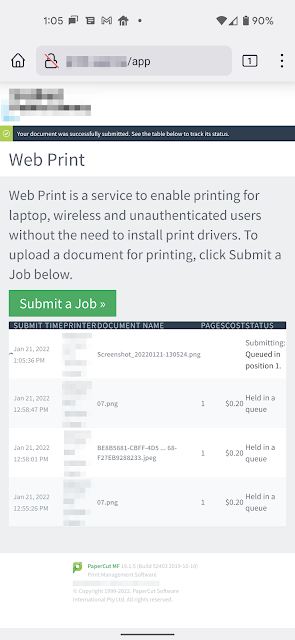
Papercut's User Web Print interface is typically like this.


What the CSS changes I have put down below will change the look from that to this.

You will note the larger text , and buttons.  I have done away with the sidebar; making this much more visible on mobile.

Here is the CSS to make papercut user web print mostly web responsive.

The key is adding "@media (pointer:none), (pointer:coarse) {" to the user-refresh.css located typically in the $Drive\Program Files\PaperCut MF\server\webapp-52403\css\user-refresh.css

The following css will give you a good start on making the papercut web client much more accessible to the user.


@media (pointer:none), (pointer:coarse) {

#main{

margin-left:0px !important;

}

#header{

height:150px !important;

}

#header-logo{

height: 150px !important;

}

#header-logo img{

height: 150px !important;

}

#container:before{

display:none !important;

width:0px !important;

}

h1{

font-size: 48pt !important;

}

h2{

font-size:42pt !important;

}

.filter{

display: none !important;

}

.web-print-intro #web-print-intro-msg{

font-size: 36pt !important;

}

a.btn{

font-size:36pt !important;

margin-left:auto;

margin-right:auto;

padding:36px;

}

table.results th {

    height: auto;

    text-align: left;

    height: 0;

    padding: 8px 1rem;

    text-transform: uppercase;

    letter-spacing: .05em;

    color: rgba(255, 255, 255, 0.7);

    background: #293e50;

    font-size: 14pt;

    line-height: 1;

    font-weight: normal;

    white-space: nowrap !important;

    margin:0px;

    padding: 0px;

}

table.results th, table.results td{

font-size: 21pt !important;

margin:0px;

padding:0px;

}

input[type=checkbox], input[type=radio]{

background-color: #293e50 !important;

margin:4px;

padding:16px;

}

label{

overflow: hidden;

white-space: nowrap;

text-indent: -15px;

width:400px;


}

.wizard-heading{

font-size: 24pt;

}

.no-web-print-jobs{

font-size:18pt;

}

.wizard{

font-size:14pt;

}

.buttons{

font-size:24pt;

padding:12px;

margin-left:auto;

}

.wizard div.buttons input{

font-size:18pt !important;

padding:16px !important;

}

.form{

font-size:18pt !important;

padding:16px !important;

}

.form input{

font-size:18pt !important;

padding:16px !important;

}

td.fields{

font-size:18pt !important;

padding:16px !important;

}

.dropzone-div{

font-size:18pt !important;

padding:16px !important;

}

#dropzone-table{

font-size:18pt !important;

padding:16px !important;

}

#file-format-details{

font-size:12pt !important;

}

#dropzone-button{

font-size:18pt !important;

padding:16px !important;

}

#upload-from.dz-clickable{

font-size:16pt !important;

padding:16px !important;

}

th.desc{

padding:0px !important;

}

.dz-filename{

font-size:16pt !important;


}

.dz-size{

font-size:16pt !important;

}

.dropzone .dz-preview .dz-details img, .dropzone-previews .dz-preview .dz-details img{

width:200px !important;

height: 200px !important;

}

td{

font-size:16pt !important;

}

.smallText, .help-block {

    font-size: 18pt !important;

    color: #8e959e !important;

    margin: 0 !important;

}

#footer{

position: absolute !important;

}

}


Here are some screenshots with the end result.



Tuesday, February 09, 2010

Why Flash will die

Adobe Flash (http://www.adobe.com/products/flashplayer/) is quickly becoming the bane of the internet. Mostly used for online video or interactive websites, flash is quickly becoming a hassle that people don't want to deal with. Within the last year Flash has become the main vector for many malware attacks. Flash also has major issues with causing the CPU to max out, browsers crashing, and memory management. Flash is also not as good for SEO and can lower your ranking on search engines.

A brief history on Flash

Flash has been until now the best platform for delivering low bandwidth highly interactive web objects. What does that mean? Well, Flash has been a great platform for delivering interactive content and eventually making up most of the video on the web. This was due mostly to ActionScript; a programmable language for Flash that allows you to do things you couldn't do before on the web with ASP, PHP, ROR (Ruby on Rails), Perl CGI, JavaScript, QuickTime and windows media player. Flash showed much of it's promise in Version 6. That is where ActionScript became really useful, and more mainstream starting to replace the older program Director, which was almost the same program just raster based with a language called Lingo and had much more CPU and Ram requirements. Director was also given the same options as Flash for posting it to the internet via The Shockwave plug in, but did not catch on as much as Flash did, probably due to the size of the player files, and the lack of bandwidth most internet users had at the time. Flash has quickly come to be the leading video player of choice on the web, and there is no better example of this then youtube. This was probably due to flash being able to read the length of time in the "Flash Video" and the communication capabilities between different swf files where you can put in "markers" or "hotspots" to trigger events in flash players.

So why will Flash Die?

To put it simply, there is a shift to move things on the web to open source and open standards preventing any one company from controlling the web. That is only part of the story. Flash has also drifted away from why people used it in the first place. A low bandwidth solution for providing highly interactive content. Flash as it has matured has become more bloated due to request from flash users for more features and capabilities. Eventually I think Flash will disappear from the web all together unless Adobe does 3 things.

  1. Makes Flash Open Source

  2. Fixes Flash from hogging the Processor and Memory

  3. Stops Flash from crashing web browsers


Most of the things done in flash now with the exception of a few items can be done now with javascript and css. With the move to web standardized content management systems which pretty much eliminates flash unless you put in a Flash Banner, Gallery, video player or some other flash element which has to be custom coded, Flash becomes very inconvenient to implement into websites. If Adobe were to open up Flash and get partners like Microsoft, Apple, Google, and Yahoo to sign on and make flash freely available to everyone to make it easy and very cheap to produce flash swf files. This might be enough for Flash to become a true web standard and have HTML 5 have a native tag just for flash instead of using Active X (which is what they did for video). The odds of this happening are slim to none, it's hard enough to get these guys to agree on anything, let alone release control of their own technologies for an open technology that standardizes everything, which would be a benefit to us all. If Adobe wants flash to live on into the the future I think they have to open it up or it will go the way Director did into oblivion.

Removing Show Recent History and Recently Open Documents from Windows Explorer

How to remove the Recent History and Recently Open Documents from Windows Explorer Using the Registry Editor Press the Windows Key + R, type...